A2 Listening (Luisteren): practise for the inburgering exam
Get used to Dutch spoken at normal speed, in the short everyday scenes the A2 exam is built from.
14-day money-back guarantee · cancel anytime
Lessons, vocabulary, practice sets and timed mock exams for A2 Listening.
See all plansThe A2 Listening exam at a glance
These facts come from the exam format our course is built on. For your own exam date and rules, DUO’s website is the place to check.
- Duration
- 45 minutes
- Questions
- 25 questions
- Pass mark
- 60% of the points
- What is scored
- Correct answers
Parts of the exam, in order
- Questions about a fragment25 questions
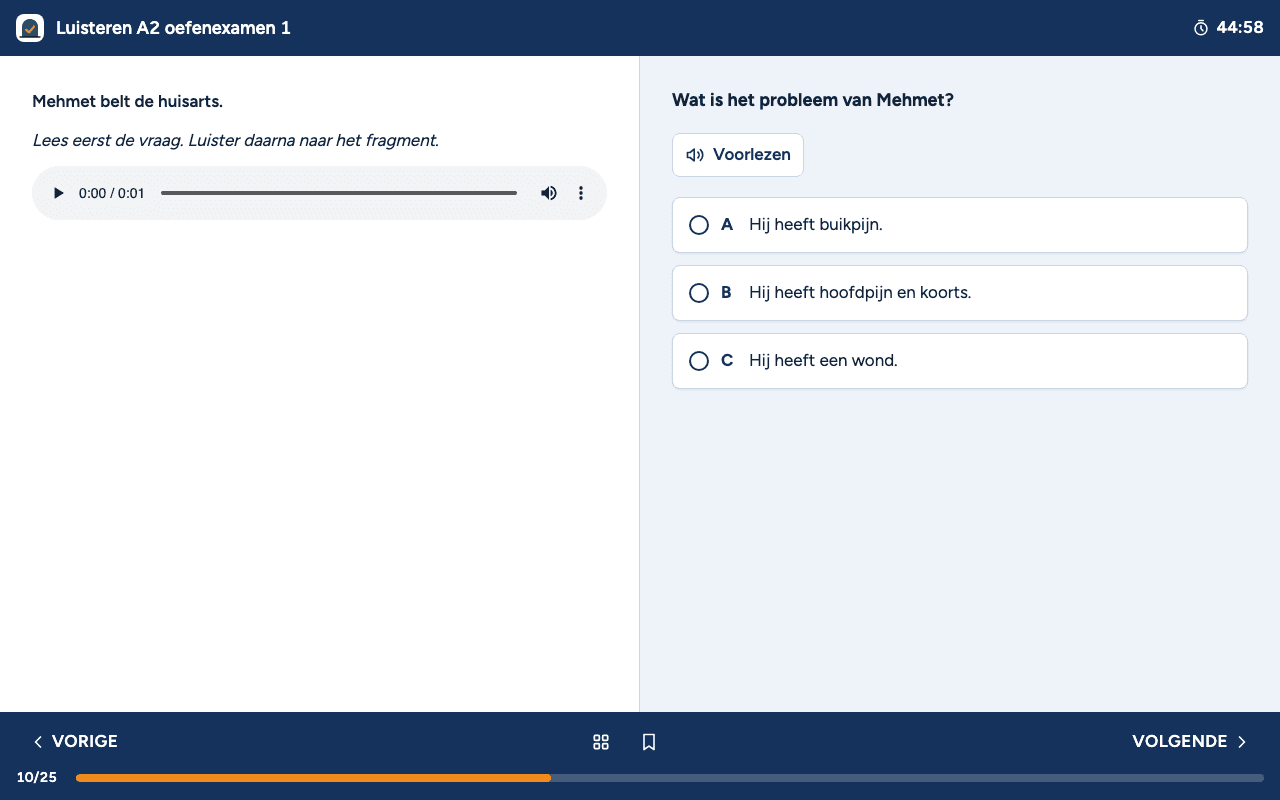
What the A2 Listening exam tests
In the A2 Listening exam you watch and listen to short fragments: two people talking at a counter, a phone call, a message on an answering machine, an announcement. After each fragment you answer questions about what you heard by choosing an answer.
The exam does not test whether you understand every sentence. It tests whether you catch the information that matters in that situation: what the person wants, when something happens, where someone has to go, or what goes wrong.
Each question gives you time to look at the situation and the choices before you decide.
For most learners the challenge is speed. People in the fragments speak at a normal pace, they swallow the ends of words, and they do not repeat themselves for you. The good news is that the A2 scenes are short and predictable: once you know the common situations, you know roughly what will be said before it is said.
Conversations
Two people at the doctor, in a shop or at the town hall. The questions are about what they agree on or what one of them asks for.
Messages and calls
Someone leaves a message or calls to change an appointment. You catch the new time, the place or the thing to bring.
Announcements
A short spoken notice at a station, in a supermarket or at school. You hear what changes and who it is for.
What is in the A2 Listening course
The course starts with how the listening exam works: how fragments and questions are grouped, what you see on screen and how the score is worked out. Strategy lessons then show how to listen with a goal, how to use the picture to predict the topic, and how to deal with a fragment you only half understood.
All listening material is made for this course with Dutch voices, a different voice for each speaker. Where the exam format uses video, the fragments play as a short video with people talking; otherwise you see a scene photo while the audio plays. Word lists with audio cover the phrases you hear most in these scenes, such as making an appointment, asking for directions and paying.
Practice sets let you replay a fragment and read an explanation that tells you exactly where in the conversation the answer was. Mock exams follow the exam order and timer, with no explanations until you finish.
Try to listen a little every day, even for ten minutes. Start with practice sets on one type of scene, replay the fragments you missed, and read the explanation only after your second try. When the practice sets feel easy, take a mock exam and compare your score with the pass mark on this page.
What the course holds today
- 9 lessons
- 109 words
- 30 practice questions
- 3 mock exams
- Listening fragments as video or photo, with Dutch voices
- Mock exams with the exam’s own timer and order
- Explanations in English and Dutch, on your phone or computer
Tips for A2 Listening
Read the question before you press play
If you know you need a time, you listen for numbers. If you need a place, you listen for street names and buildings. A question read in advance turns a fast fragment into a search for one thing.
Use the picture
The scene tells you a lot before anyone speaks: a waiting room means an appointment, a counter means a request. Let it set your expectations so the words fall into place.
Listen for the change
Many fragments contain a correction: "not Tuesday, but Thursday". The first option you hear is often the wrong answer. Wait for the end of the sentence before you decide.
Accept that some words pass by
Spoken Dutch joins words together and drops sounds. You will miss some of it, and that is fine. Hold on to the words you do catch and choose the answer that fits them.
Who the A2 Listening course is for
The course is for anyone who must pass Listening at A2. Check your requirements on DUO’s inburgering site(opens in a new tab), or read our exam information to see how the exam parts fit together.
It is especially useful if you read Dutch better than you understand it, which is common for people who learned from books or apps. Hearing many different voices at normal speed is what closes that gap, and the course gives you a lot of them.
Use headphones when you can. Short daily practice helps your ear more than one long session a week.
Listening also helps the rest of your exam. The phrases you learn to hear here are the same ones you will need to say in Speaking.
What it costs
Monthly, cancel anytime. Ask within 14 days of your first payment and you get your money back.
Questions about A2 Listening
Can I listen to a fragment more than once?
In practice sets you can replay a fragment as often as you like. Mock exams follow the rules of the exam format, so you practise under the same conditions as on the day.
Are the voices real Dutch speakers?
The fragments use natural Dutch neural voices, a different one for each speaker, and some scenes are shown as video. Every fragment is made once and stored, so it always plays the same.
I understand written Dutch but not spoken Dutch. Will this help?
Yes, that is exactly what the course trains. You hear many short scenes at normal speed, with explanations that show where the answer was said.
How is A2 Listening scored?
The block at the top of this page shows the pass mark and what is scored, from the exam format the course uses. Each mock exam ends with your score and a review of every question.
Can I practise on my phone?
Yes, with headphones it works well. Take at least one mock exam on a computer too, since that is how you sit the exam.
Which situations do the fragments cover?
Everyday scenes from life in the Netherlands: the doctor, the shop, the municipality, school, work, public transport and phone calls. The word lists follow the same themes.
What if it is not for me?
Ask for a refund within 14 days of your first payment and you get your money back in full. You can cancel any time; access runs until the end of the paid month.