B1 Listening (Luisteren): practise for the inburgering exam
Learn to follow longer Dutch conversations and interviews, using the reading time well and catching the answer the first time.
14-day money-back guarantee · cancel anytime
Lessons, vocabulary, practice sets and timed mock exams for B1 Listening.
See all plansThe B1 Listening exam at a glance
These facts come from the exam format our course is built on. For your own exam date and rules, DUO’s website is the place to check.
- Duration
- 90 minutes
- Questions
- 40 questions
- Pass mark
- 500 out of 1000
- What is scored
- Correct answers
Parts of the exam, in order
- Questions about a fragment40 questions
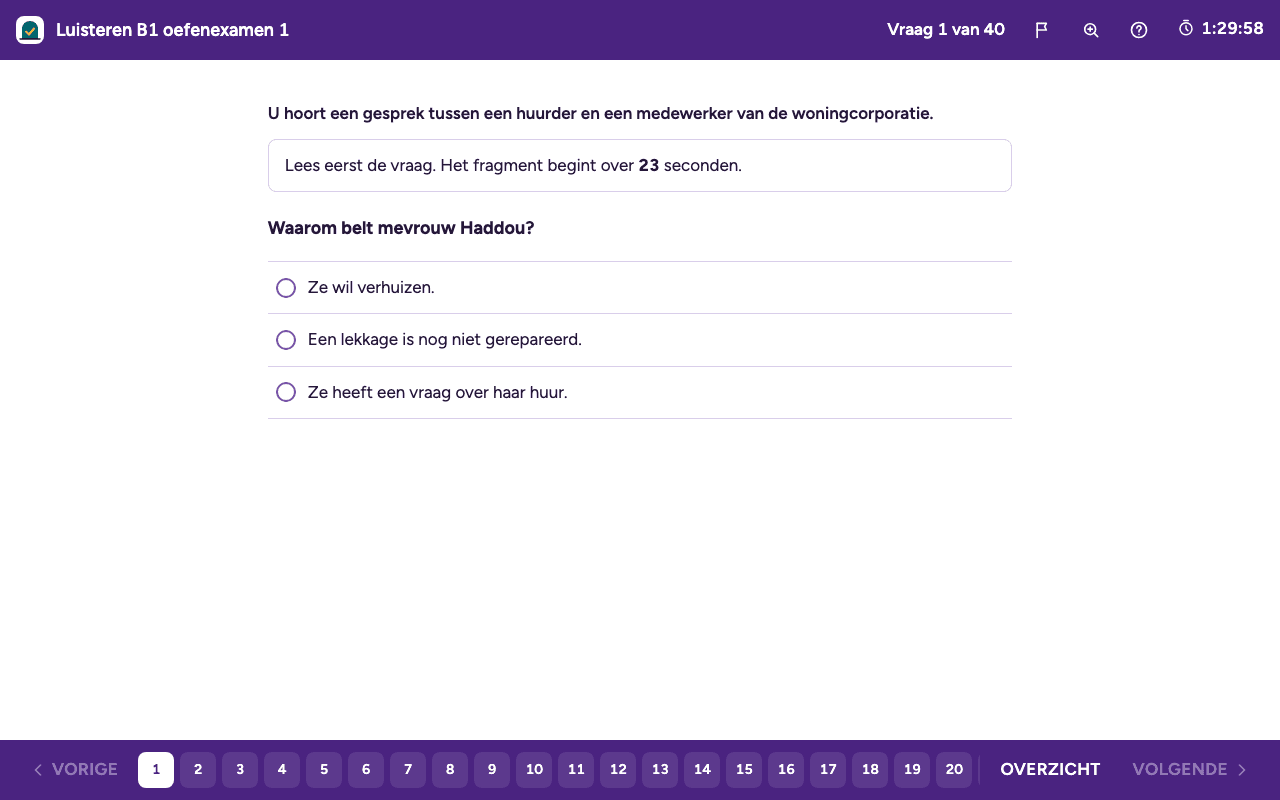
What the B1 Listening exam asks of you
At B1 the fragments come closer to real life: a radio interview, a discussion between colleagues, an explanation at an information evening, a phone call with several turns. You answer questions about the facts you hear, but also about what speakers think, want or agree on.
In the B1 format our course follows, you get time to read the questions before a fragment starts, and the fragment plays once. That changes how you prepare: reading well beforehand is half the work.
The hardest part for most learners is that there is no second chance. If your attention drops for a few seconds, the answer may be gone. That is why the course trains concentration and preparation as much as understanding: what to read before the fragment, what to listen for and when to let go.
Interviews and talks
One person explains something, and another asks questions. You follow the main point and the reasons given.
Discussions
Two or more people disagree or plan something. You track who wants what and how it ends.
Information and instructions
A spoken explanation of a procedure or a rule. You pick out the step, the condition or the exception that the question is about.
How the B1 Listening course trains you
The course explains the B1 listening format first: the reading time, the single play, the grouping of questions per fragment and how the score works. Strategy lessons then teach active listening for B1: predicting from the questions, recognising signal words, and keeping track of more than one speaker.
All fragments are recorded for the course with Dutch neural voices, each speaker with a voice of their own. Some scenes play as video, others as a photo with audio. Word lists with audio focus on spoken B1 language, including the fixed expressions people use to agree, doubt or change the subject.
In practice sets you can replay fragments and read where the answer was said. Mock exams switch to the B1 conditions: reading time, one play, and the exam order and timer.
A useful routine is to do a practice set first with replays, then the same type of fragment under mock conditions. Compare the two scores: the gap shows how much the single play costs you, and it should shrink over the weeks.
What the course holds today
- 11 lessons
- 125 words
- 40 practice questions
- 3 mock exams
- Listening fragments as video or photo, with Dutch voices
- Mock exams with the exam’s own timer and order
- Explanations in English and Dutch, on your phone or computer
Tips for B1 Listening
Most of the tips below are about attention rather than language. Try them in the practice sets first, with replays available, and then use them in a mock exam where the fragment plays only once.
Use every second of the reading time
Underline in your head what each question asks: a reason, an opinion, a time. When the fragment starts, you are listening for those words only.
Note who says what
In a discussion, the answer often depends on the speaker. Keep track of names or of "the man" and "the woman", and of what each one wants.
Hear the opinion in the tone
Words like "eigenlijk", "nou ja" and "ik weet het niet hoor" show doubt. A speaker who says "prima" with no enthusiasm may not agree at all.
Do not stay behind
If you miss an answer, let it go and move straight to the next question. Holding on to a missed answer means missing the next one too.
Listen for turning points
Speakers at B1 often nuance their initial statement with pivot words such as "maar", "hoewel", "integendeel" or "aanvankelijk". Pay extra attention to what is said directly after these markers, as that is frequently where the definitive answer rests.
Filter out conversational fillers
Natural conversations include hesitation sounds and fillers like "nou ja", "zeg maar" and "eigenlijk". Our practice audio trains you to let these filler words pass without distraction and lock directly onto the substantive message.
Who the B1 Listening course is for
The course is for learners who must pass Listening at B1. Check your integration requirements on DUO’s inburgering site(opens in a new tab), and consult our exam information to plan your study.
It is a good next step after A2 Listening, and a must if you can hold a conversation one to one but lose track when people talk faster or with each other. The many voices and the single play of the mock exams build the stamina the B1 exam needs.
Outside the course, Dutch radio, podcasts and the news are good extra practice. Listen for the main point first, and do not worry about every word.
What it costs
Monthly, cancel anytime. Ask within 14 days of your first payment and you get your money back.
Questions about B1 Listening
Does the fragment really play only once?
In the B1 format our mock exams follow, yes, after a reading time. In practice sets you can replay as often as you want, so you can learn before you test yourself.
Is there video in B1 Listening?
Some fragments are shown as video of people talking, others as a photo with audio. Both are made for the course and play the same every time.
How is B1 Listening scored?
The format block near the top of this page shows the pass mark and how answers count, from the exam format the course uses. Each mock exam ends with that score.
I struggle with fast speakers. Is B1 too hard for me?
Not necessarily. Start with the practice sets, where you can replay, and use the strategy lessons on predicting. Speed gets easier with many short sessions.
Should I use headphones?
Yes, when you can. They help you hear details and get you used to listening with a headset, as you do in the exam.
Can I see the questions before the fragment plays?
Yes. In the B1 format there is reading time before each fragment, and the mock exams give you that time too. The lessons teach you how to use it.
How do I cancel or get a refund?
Cancel any time from your billing page; you keep access until the end of the month you paid for. Within 14 days of your first payment you can ask for a full refund.