B1 Speaking (Spreken): practise timed answers
Get used to answering at the beep, within the time, with a clear opinion and a reason.
14-day money-back guarantee · cancel anytime
Lessons, vocabulary, practice sets, timed mock exams and AI feedback on every answer for B1 Speaking.
See all plansThe B1 Speaking exam at a glance
These facts come from the exam format our course is built on. For your own exam date and rules, DUO’s website is the place to check.
- Duration
- 25 minutes
- Tasks
- 16 tasks
- Pass mark
- 500 out of 1000
- What is scored
- Task completion, Vocabulary, Grammar, Pronunciation, Fluency
Parts of the exam, in order
- Speaking task with a time limit8 tasks
- Speaking task with a time limit8 tasks
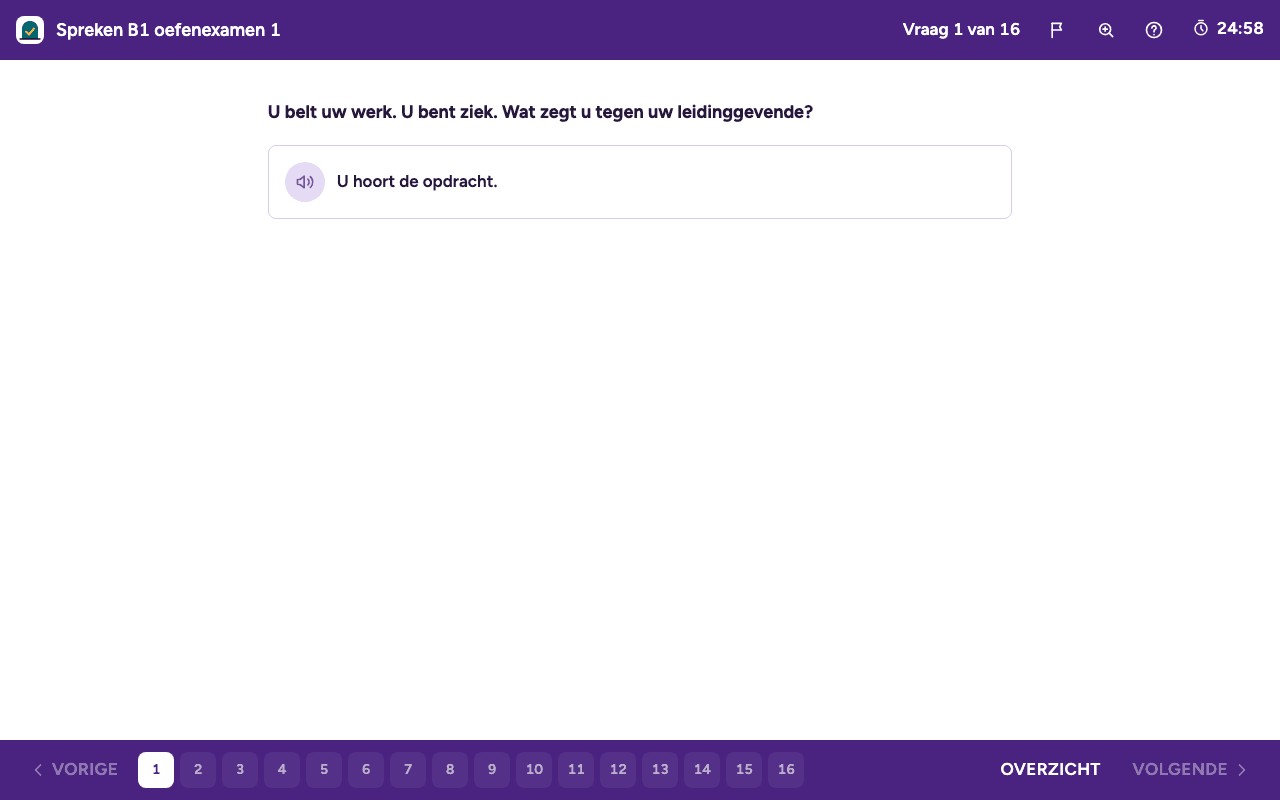
What the B1 Speaking exam asks of you
B1 Speaking is quick. A task is shown on screen, a beep sounds, and you have a fixed time to answer before the next task begins. There is no going back. The exam checks whether you can react in Dutch without long preparation, in a way a listener can follow.
Each answer is scored on the criteria of the B1 format, listed in the block above, including fluency and pronunciation.
Because you cannot go back, nerves play a big role. Learners who speak well in daily life sometimes lose points because they wait too long after the beep or stop before the time is up. The exam rewards those who keep talking in clear, connected Dutch, even with small mistakes.
Short answers
A question about a daily situation that needs a direct, complete reply: what you would say, ask or do.
Longer answers
A question that asks for more: your opinion with a reason, a comparison of two options, or advice to someone. You have more time, and the graders expect more structure.
How the B1 Speaking course trains you
You start with how the B1 speaking exam runs and how answers are judged. Strategy lessons show how to use the first seconds, how to build a longer answer in three parts, and how to sound natural with fillers that buy time.
Grammar and vocabulary lessons cover giving an opinion ("volgens mij", "ik vind dat"), agreeing and disagreeing, giving advice and talking about the past. Every example has audio, so you can say it after the speaker.
A strong B1 answer is not a list of loose sentences. It has a start that reacts to the question, a middle with a reason or an example, and a short close. The lessons show this shape in many model answers, so that after a while you use it without thinking.
You record answers in the browser. The course turns your speech into text and the AI scores it on the B1 criteria, with the transcript, corrections and a model answer. Mock exams follow the B1 rhythm: beep, answer time, next task, no way back.
Read the transcript of each answer: it shows sentences that did not finish and words that were not understood. Then record the task again with the model answer in mind. A few rounds of this on the same task build answers you can reuse on the day.
What the course holds today
- 17 lessons
- 104 words
- 60 practice questions
- 3 mock exams
- AI feedback on every written or spoken answer, scored on the exam’s criteria
- Mock exams with the exam’s own timer and order
- Explanations in English and Dutch, on your phone or computer
Tips for B1 Speaking
Practise the habits below with a timer at home, even without the course: pick a topic, set the time, and talk until it runs out. The more often you do it, the less the beep will surprise you on the day.
Start talking at the beep
Silence costs time you cannot win back. Have a starter ready, such as "Dat is een goede vraag" or "Ik denk dat…", and begin with it while you think.
Opinion, reason, example
For a longer answer, give your opinion, add a reason with "omdat", and finish with a short example from your own life. Three parts make a complete B1 answer.
Speak to the end of the time
If you finish early, add a second reason or a conclusion. A longer complete answer shows more of your Dutch.
Let small mistakes go
The exam rewards communication. Correcting yourself in the middle of a sentence breaks your flow; keep going and finish the thought.
Structure with transitions
Connect your thoughts with clear link words: "ten eerste", "daarom", "kortom". Graders listen for connections between your sentences, not just loose remarks. Transition phrases buy you thinking time while keeping your speech coherent.
Take a position immediately
When asked for an opinion on an unfamiliar topic, do not hesitate over which side to pick. Choose whichever side gives you simpler arguments, state your view right after the beep, and support it with two practical reasons before the time ends.
Who the B1 Speaking course is for
The course is for learners who must pass Speaking at B1. Check your required level on DUO’s inburgering site(opens in a new tab), or read the exam information on our site first.
It is especially useful if you can talk calmly in a real conversation but freeze when a timer runs. Practising the beep and the fixed time many times at home takes the surprise out of the exam. Use a quiet room and a headset for the best recordings.
If B1 Speaking feels far away, start with the short tasks only and add the longer ones when your starters and reasons come without thinking.
What it costs
Monthly, cancel anytime. Ask within 14 days of your first payment and you get your money back.
Questions about B1 Speaking
Can I prepare my answer before the beep?
Only for the short moment the task is shown. That is why the course trains you to start straight away with a fixed opening and build the answer while you speak.
How does the AI score my speaking?
Your recording is turned into text and graded on the B1 criteria, such as task completion, vocabulary, grammar, pronunciation and fluency. You see the transcript and how to improve it.
What happens to my recordings?
A recording is kept only until it is graded, then deleted. The transcript and feedback stay in your account.
Can I go back to a task in the mock exam?
No, just as in the B1 format our course follows. In practice sets you can redo any task as often as you like.
Do I need special equipment?
A phone or computer with a microphone and a modern browser is enough. A headset gives clearer recordings.
How long is each answer?
The answer time per task comes from the exam format and is shown during practice and mock exams. Longer tasks give you more time than short ones.
Can I get my money back?
Yes, within 14 days of your first payment, in full; your access then ends. You can also cancel at any time and use the course until the paid month ends.