B1 Writing (Schrijven): practise with AI feedback
Practise every B1 writing task and get feedback on content, structure and language on each answer you write.
14-day money-back guarantee · cancel anytime
Lessons, vocabulary, practice sets, timed mock exams and AI feedback on every answer for B1 Writing.
See all plansThe B1 Writing exam at a glance
These facts come from the exam format our course is built on. For your own exam date and rules, DUO’s website is the place to check.
- Duration
- 100 minutes
- Tasks
- 12 tasks
- Pass mark
- 500 out of 1000
- What is scored
- Task completion, Vocabulary, Grammar, Spelling and punctuation, Coherence
Parts of the exam, in order
- Finish a sentence8 tasks
- Fill in a form2 tasks
- Write a short text1 task
- Write a longer text1 task
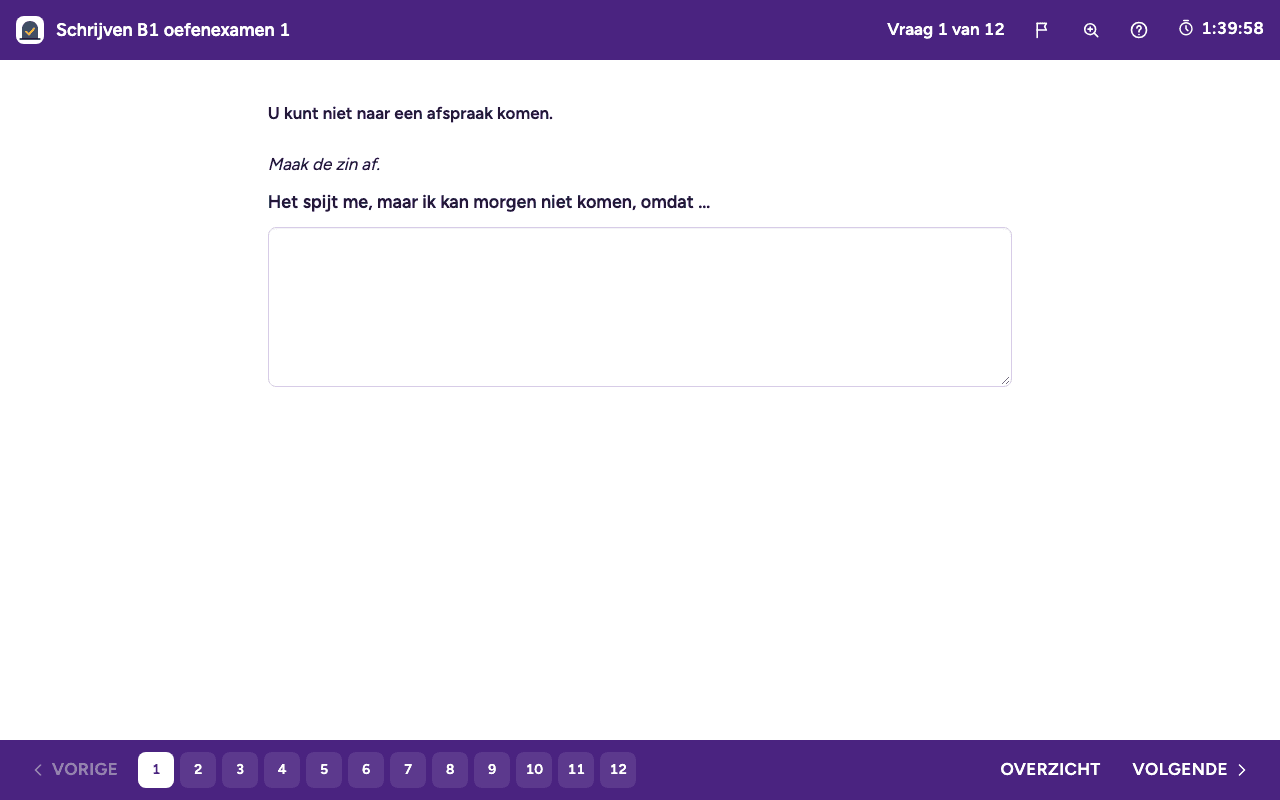
What the B1 Writing exam asks of you
B1 Writing shows whether you can write clear, connected Dutch for work, school and contact with organisations. The exam mixes small tasks and larger ones, so you need both accuracy in a single sentence and the ability to build a whole text.
At B1 the criteria include coherence: how well your sentences and paragraphs connect. The format block above lists every criterion of the format our course follows.
Learners often pass the small tasks easily and lose their points on the longer text. They have ideas, but the text jumps between them, the reader cannot follow the reasoning, or the ending is missing. The B1 course spends extra time on exactly that step from good sentences to a good text.
Finishing sentences
You complete the second half of a sentence so that it is correct and makes sense. It tests grammar and linking words in a tight space.
Writing in parts
A task in smaller steps, for instance the fields of a form or the separate parts of a reply. Each part needs to be right on its own.
A short text
A message or note in a few lines, with a clear purpose: inform, ask or react.
A longer text
The largest task: you explain a situation, give your opinion or make a proposal, with reasons, in a text with a beginning, middle and end.
How the B1 Writing course trains you
You start with how B1 writing is scored and what separates a pass from a fail. Then strategy lessons go through the four task types, each with an annotated example answer that shows structure, linking words and typical B1 phrases.
Grammar lessons focus on what B1 writing needs most: the verb at the end of a subordinate clause, the perfect and imperfect tense, formal and informal address, and words that structure a text, such as "ten eerste", "daarnaast" and "kortom".
You write a lot. Every answer you type gets AI feedback on the B1 criteria: a score per criterion, your mistakes marked in your own text, comments on structure and a model answer. Mock exams give you the full set of B1 writing tasks within the time of the exam format.
Rewrite your longer texts after the feedback and have them graded again. Seeing your coherence score rise after you add a clear opening and linking words teaches more than any rule. Over time the feedback history shows which grammar points still trip you up.
What the course holds today
- 19 lessons
- 92 words
- 120 practice questions
- 3 mock exams
- AI feedback on every written or spoken answer, scored on the exam’s criteria
- Mock exams with the exam’s own timer and order
- Explanations in English and Dutch, on your phone or computer
What AI feedback on your writing looks like
An example from the course: an email task, a learner’s answer and the feedback. In the course you get this on every answer you write.
The task
Je buurvrouw Anja heeft je geholpen met verhuizen. Schrijf haar een e-mail. Bedank haar en nodig haar uit voor koffie. Noem een dag en een tijd.
The answer
Beste Anja,
Dank je wel voor je hulp met de verhuizing. Zonder jou ik was1 nog lang niet klaar. Ik wil je graag uitnodigen voor koffie bij mij thuis, op zondag middag2 om drie uur. Kun je dan?
Hartelijke groet,
SamirThe feedback
The email does everything the task asks: it thanks Anja and names a day and a time. Two small points cost marks.
Word order. After “Zonder jou” the verb comes first: “Zonder jou was ik”.
Spelling. Day and part of the day are one word: “zondagmiddag”.
The improved sentences
Zonder jou was ik nog lang niet klaar. Ik wil je graag uitnodigen voor koffie bij mij thuis, op zondagmiddag om drie uur.
Tips for B1 Writing
Take the tips below one at a time: use one in every text for a week, watch its effect in the feedback, then add the next.
Make a mini plan for the long text
Before you write, put three words on paper: your opening, your main reason and your closing. A planned text is easier to write and earns points for coherence.
Use linking words on purpose
B1 graders look for connections. Words like "omdat", "daardoor", "maar" and "daarom" turn a list of sentences into an argument.
Choose u or je once
A letter to an organisation uses "u"; a message to a friend uses "je". Pick the right one at the start and keep it to the end.
Check the verb at the end
After "omdat", "dat" and "als", the verb moves to the end of the clause. Reread every subordinate clause once for this before you hand in.
Leave time to reread
Keep the last minutes for checking. Most mistakes are ones you would spot yourself on a second read.
Vary your sentence structure
Instead of starting every sentence with the subject, begin some sentences with an adverbial phrase of time or place ("Vorige week...", "Tijdens de vergadering..."). This inversion demonstrates higher syntactic flexibility at B1 level.
Who the B1 Writing course is for
This course is for learners who need Writing at B1. Check your exam level with DUO on DUO’s inburgering site(opens in a new tab), and consult our exam info page for details.
It suits you if you write simple Dutch already and want to reach the structure and range that B1 asks for. The steady feedback on your own texts shows which mistakes keep coming back, so you know exactly what to work on.
It also helps if you write Dutch at work or plan to study in Dutch: the formal letters and structured texts of B1 are the same ones you will need there.
What it costs
Monthly, cancel anytime. Ask within 14 days of your first payment and you get your money back.
Questions about B1 Writing
What does the AI look at in my B1 text?
The criteria of the B1 format: whether you completed the task, vocabulary, grammar, spelling and how well your text hangs together. You get a score per criterion, corrections and a model answer.
Is the AI score the same as the exam score?
No. It is an estimate to guide your practice. It uses the same criteria, but your real exam is graded by people and the result can differ.
How many texts can I have graded?
There is a daily limit on AI grading that is generous for normal study. Lessons and closed exercises are not limited.
Does the course teach formal letters?
Yes. Writing to an organisation, an employer or a school is a large part of B1, and the lessons cover the openings, closings and polite phrases you need.
Is there an example of the feedback?
Yes, this page shows an annotated example on an email task. In the B1 course the feedback also comments on the structure of your longer texts.
I already passed Writing at A2. Do I still need this?
B1 adds the longer text and coherence as a criterion. If you have never written a structured text in Dutch, this course is where to practise it.
What if I want to stop?
Cancel whenever you like; access lasts until the end of the paid month. Within 14 days of your first payment you can ask for a full refund instead.